Shuchi Chawla, Madhur Tulsiani, and I are organizing a new summer school aimed at exposing undergraduate students to research directions in theoretical computer science and its applications. The school will take place from May 31 till June 4, 2021. This first iteration will be online, but we hope it will become a recurring and lasting event. … Continue reading New summer school in TCS
Unsupervised Learning and generative models
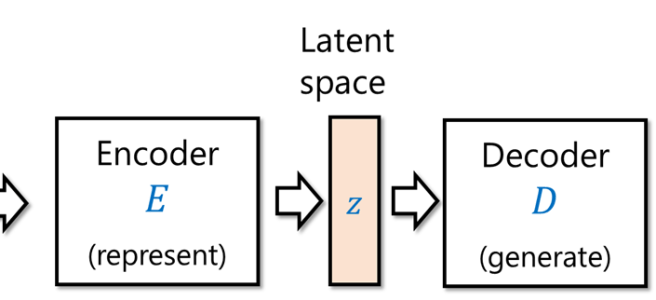
Scribe notes by Richard Xu Previous post: What do neural networks learn and when do they learn it Next post: TBD. See also all seminar posts and course webpage. lecture slides (pdf) - lecture slides (Powerpoint with animation and annotation) - video In this lecture, we move from the world of supervised learning to unsupervised … Continue reading Unsupervised Learning and generative models
What do deep networks learn and when do they learn it

Scribe notes by Manos Theodosis Previous post: A blitz through statistical learning theory Next post: Unsupervised learning and generative models. See also all seminar posts and course webpage. Lecture video - Slides (pdf) - Slides (powerpoint with ink and animation) In this lecture, we talk about what neural networks end up learning (in terms of … Continue reading What do deep networks learn and when do they learn it
A blitz through classical statistical learning theory
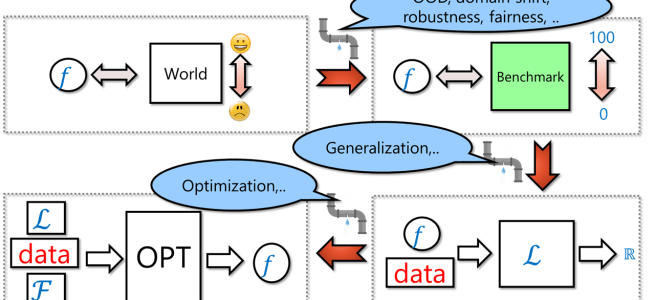
Previous post: ML theory with bad drawings Next post: What do neural networks learn and when do they learn it, see also all seminar posts and course webpage. Lecture video (starts in slide 2 since I hit record button 30 seconds too late - sorry!) - slides (pdf) - slides (Powerpoint with ink and animation) … Continue reading A blitz through classical statistical learning theory
ML Theory with bad drawings

(Next post: Lecture 1 - a blitz through classical statistical learning theory . See also all seminar posts) This semester I am teaching a seminar on the theory of machine learning. For the first lecture, I would like to talk about what is the theory of machine learning. I decided to write this (very rough!) … Continue reading ML Theory with bad drawings
Obfuscation: The season 4 Finale

For many of the famous open problems of theoretical computer science, most researchers agree on what the answer is, but the challenge is to prove it. Most complexity theorists (with few notable exceptions) believe that P≠NP, but we don't know how to prove it. Similarly, most people working on matrix multiplication believe that there is … Continue reading Obfuscation: The season 4 Finale
Making TCS more connected / less insular
[Announcement from Jelani Nelson --Boaz]TL;DR: https://tinyurl.com/tcs-connections A task force has been convened by CATCS to investigate possibleapproaches to modifying aspects of the TCS community, especially ourpublishing culture, to enhance connections with other areas of CS andbe as welcoming as possible to a broad range of contributions withintheory. This committee will collect and synthesize feedback from … Continue reading Making TCS more connected / less insular
On Galileo Galilei and “denialism” from elections to climate to COVID

Galileo Galileo has many self-appointed intellectual heirs these days. Whether it's a claim that the election has been stolen, that COVID-19 is less fatal than the flu, that climate change or evolution are hoaxes, or that P=NP, we keep hearing from people considering themselves as bold truth-tellers railing against conventional wisdom. We are encouraged to … Continue reading On Galileo Galilei and “denialism” from elections to climate to COVID
Announcing the WiML-T Mentorship Program (guest post)
[Guest post by Claire Vernade, Jessica Sorrell, Kamalika Chaudhuri, Lee Cohen, Mary Anne Smart, Michal Moshkovitz, and Ruth Urner. I am very happy about this initiative - mentoring and community is so important for success in science, and as I've written before, there is much work to do so women will have the same access … Continue reading Announcing the WiML-T Mentorship Program (guest post)
Updated Research Masters programs database by Aviad Rubinstein and Matt Weinberg
Guest post by Aviad Rubinstein and Matt Weinberg As explained in Boaz's previous posts [1] [2], the PhD admission process can be challenging for students who discover their passion for Theory of Computer Science late in their undergraduate studies. Discovering TCS earlier is especially challenging for students who aren't exposed to CS in high school, … Continue reading Updated Research Masters programs database by Aviad Rubinstein and Matt Weinberg
 Windows On Theory