October 1, 2026 · Erik Brynjolfsson and Chad Jones · Scribe notes by Kathryn, Eli, Sam, and Christopher
Notes from CS 2881R: AI Alignment and Safety, Harvard, Fall 2026.
Lecture video · Chad Jones’s slides · Experiment code
Author Introductions
Kathryn: Senior studying Computer Science and pursuing a concurrent master’s degree in Computer Science. I’ve spent the past three summers working as a software engineer at AWS, and I’m currently researching AI safety, specifically how misaligned behaviors spread and can be corrected in multi-agent systems. I took this class to better understand the risks that emerge as AI systems become more autonomous and how we can design systems that remain safe and reliable as they scale.
Eli: Sophomore studying Computer Science and Philosophy. Returned from a leave of absence working at an AI startup working with financial and operational data from mid-market manufacturing companies up to the F500. I took this class to deepen my understanding of the practical risks of AI as they continue to become more powerful.
Sam: Junior studying Computer Science and Mathematics, pursuing a concurrent master’s degree in Computer Science. I worked on machine learning research this past summer and during school, focusing on RL and optimizer research for LLMs. I’m taking this class to better understand mechanistic interpretability and safety.
Christopher: Sophomore studying Mathematics and Computer Science, pursuing a concurrent master’s degree in Statistics. Since this past summer, I have been working on machine learning and quantum computing research to provide new insights into the interpretability of such models. I took this class to build a stronger foundation in AI safety and interpretability and explore how these principles can inform future work in machine learning.
Outline
This post will discuss 4 parts of the lecture:
- The Turing Trap is an Alignment Problem
- Chad’s Perspective:
- Q&A:
- Experiment: What is the best AI economy?
Part I: The Turing Trap is an Alignment Problem
Speaker Erik Brynjolfsson
The majority of AI research today centers around training machines that can perform the same tasks as humans. However, while human tasks provide an easy evaluation metric for how powerful AI models are becoming, this goal is fundamentally misaligned.
There is the concept of automation vs. augmentation. The former is when a human is replaced by a machine that does the same job as the human. The latter is when the human and machine work together, accomplishing tasks beyond what the human and machine can each perform alone. Augmentation is preferable to automation, because the set of tasks that a “centaur”—a human-machine hybrid—can perform is strictly a superset of the set of tasks that each can perform alone. However, there also exist economic reasons to prefer augmentation over automation.
Imitation of humans tends to create wealth and power disparities. People often hold economic power precisely because their labor is necessary. When their labor is no longer needed, they are deprived of economic power, which shifts to whoever owns the technology. In addition, automation can also lead to an increase in concentration of political power as those with more powerful technology could utilize it to accomplish oppressive objectives. Therefore, concentration of political power, and not merely economic power, is a paramount concern.
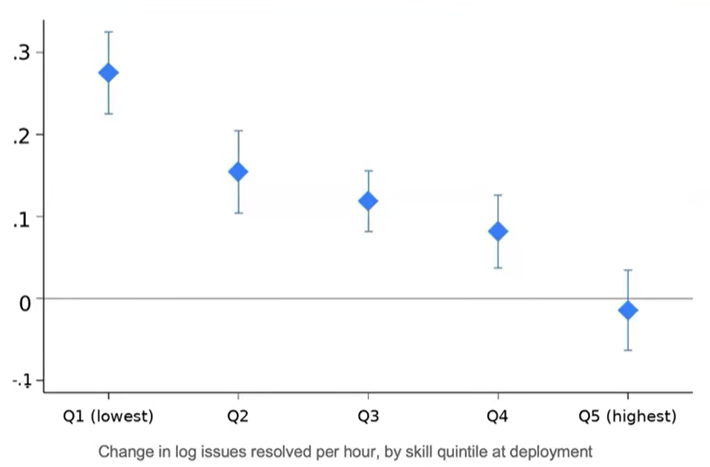
To fully address this issue, we must use data. In a 2025 study coauthored with Danielle Li and Lindsey Raymond, Erik examined AI assistance for 5,172 customer-support agents at a Fortune 500 software firm. The largest gains went to the least experienced and lowest-skill agents: the assistant codifies what the best agents know and hands it to everyone else, meaning that the skill distribution compresses. The tenure result is that agents with two months on the job and the AI assistant did about as well as agents with six months who didn’t have it. 15% more issues were resolved per hour on average, with roughly 30% more for the least skilled. Notably, the top quintile employees (top 20%) did not get any boost from AI in terms of issues resolved, and this observation held across many different metrics. One intuitive explanation as to why this happens is as follows: if there is a right answer to the problem, then the most experienced workers will always get the right answer anyway, so there isn’t much improvement, but the lower-skill employees will see significant gains in their ability to reach the right answer. However, if there is some continuously increasing metric, it may be possible for the more skilled workers to gain more out of using AI: this will have to be further investigated.
Another study was done on employment growth, stratified across age ranges. It was observed that employment growth has slowed for the youngest workers (aged 22-25), with the growth curve slowing to flat, while the growth curve for older workers continues to increase. For some professions (like SWE) we have significant declines in young workers. This leads us to an attempt to rank occupations by how exposed they are to AI. We do this by breaking down each profession into tasks, seeing how much each task can be taken over by AI, then determining how much of the overall profession can be taken over by AI, as it is far easier to examine whether a specific task can be automated by AI rather than an entire profession. When taking AI exposure into consideration, we found that the least AI-exposed occupations grew fastest for younger workers: composition, not collapse. However, highly AI-exposed occupations slowed dramatically, and sometimes even dipped. Notably, the slowing growth curve for these occupations is generally not due to companies firing workers, but is rather driven by a decrease in hiring. This was an observational study, so no causal relationship can be immediately established, but other factors were studied (including interest rates, tech overhiring, remote work, and education), with none making a fundamental difference in the pattern.

Fact 5 from Canaries in the Coal Mine (coauthored with Bharat Chandar and Ruyu Chen) supports similar results: using Anthropic data on how people use Claude, it was found that professions that primarily used AI to automate work were correlated with falling employment, while professions that used it to complement work were correlated with rising employment. In the August update, it was found that young workers in the most exposed occupations are about 19% below their less-exposed peers in terms of employment.
One can put the economics of AI into perspective with something called the “Mismeasurement J-Curve”, a model that attempts to estimate how mismeasured the value of a new technology is. Note that this doesn’t have to apply to AI: it could also be used for other technologies. The general cycle is this: when an exciting new technology (like AI) comes about, there is significant investment in it, but as the technology is so new, it cannot be applied directly to create profit yet. Thus, we’re making investments in “intangible assets”: these are very important, but they don’t get counted in GDP growth (as they’re not being used to create goods and services yet), so in the short-term we get an increase in input but no increase in output. Thus, productivity is measured as lower.
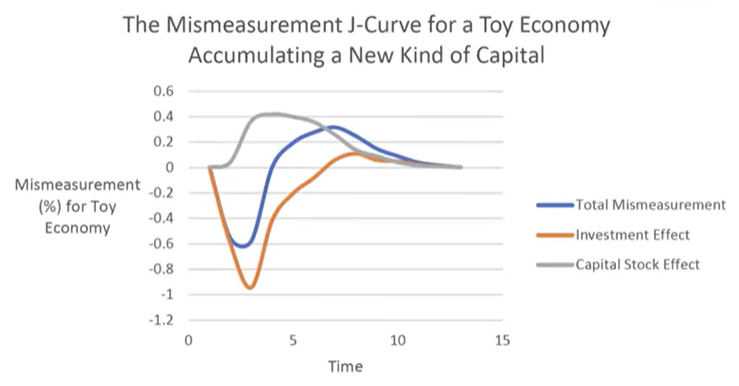
However, this is a mismeasurement of the value of the intangible asset. As we start harvesting some of the benefits from these intangibles, we haven’t previously measured them, so it looks as if the gains are coming out of thin air. In reality, these are the results from our earlier investments. Note that it wasn’t just the technology that allowed GDP to grow, but the prior investment in it, so there is a pattern of negative productivity growth before large returns. In the current AI era, we’re now starting to harvest some of the intangibles, and see some returns!
How can we best utilize these returns? The capabilities of AI models are generally measured via benchmarks. It is often easy to create benchmarks that measure how well humans do on a particular task and train machines on that: there’s plenty of data to be found, and there’s little human involvement needed. Yet, if we are to truly get the most out of our intangibles, the data clearly shows that augmentation is preferable to automation, which is the opposite of what current benchmarks are based around.
To further highlight this issue, consider the following thought experiment. Suppose that Daedalus, the famous Greek engineer of myth, had an extremely talented team of engineers that built machines automating every job the Greeks performed. Making clay pottery? Automated! Weaving tunics? Automated! Repairing horse-drawn carts? Automated! Burning incense for the sick? Believe it or not, automated! While the Greeks would certainly have a great time lounging around, they would not significantly advance as a society, because they are not pushing past their existing society. You don’t get the steam engine simply by automating all your ancient tasks. It would be better if Daedalus were to invent tools that assisted Greeks as they built faster ships, devised new kinds of tunics, and pushed the frontier.
In summary, most of the tasks that are worth doing are in the range of “new tasks humans can do with the help of machines”. As of today, not many are trying to work in this region, and for good reason. There’s a significant bias toward substitution in our society today, reinforced by business structure and the economy. For example, technologists find it easier to create automation benchmarks, as matching a human is a well-defined target, while extending one is not. For a business executive, substitution is the easiest, no-brainer thing to do. It requires little mental effort to gain benefit out of substitution, while augmentation requires novel strategies. For policymakers, labor is more tax-heavy than capital because of how the tax code works, so a machine that replaces a worker gets a tax advantage the worker never had. Each of these figures in our society is motivated in some way to work towards automation, rather than augmentation.
Because of this, there is a need for centaur benchmarks, those that measure how much AIs can extend humans, not merely how well they can complete a human task on their own. If we consider the most popular benchmarks today like SWEBench, TerminalBench, and the (quite on-the-nose) AutomationBench, these are all very automation focused. When these are the benchmarks everyone uses, AI companies are highly incentivized to make their models as strong on these automation-heavy benchmarks as possible, harming augmentation. Instead, we should create centaur benchmarks that score the person and the model together on the outcome. This incentivizes models that are built to complement humans from the ground up, not replace them.
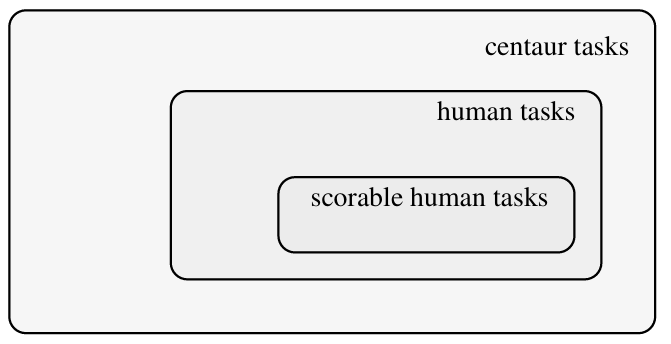
CentaurBench (created by Andreas Haupt and Erik) is an example of this. It contains 7 tasks, scored based on how well an AI model was able to assist and work with a weaker AI model on each task. Compared to an ordinary leaderboard that scored the AI models based on their own performance on the tasks, the CentaurBench leaderboard flipped. This shows that there is considerable work to be done today on making AI models better at working with humans.
In the age of AI, we are experiencing a rapid shift in how we think about work and society as a whole. Hayek in 1945 argued that central planning fails because the knowledge an economy runs on is dispersed and often tacit. Zoë Hitzig and Erik’s article “AI’s Use of Knowledge in Society” claims that AI weakens both assumptions: AI can turn tacit knowledge into explicit knowledge, and has vast processing capability able to gather this knowledge and turn it into power. AI expands whatever the holder of the model, the data, and the compute can process, and if the owners of these resources are centralized in a few companies or a single government, things could turn ugly for the rest. Ending on perhaps a more sobering note, this framework heightens the necessity of building AI that complements humans, such that in the future, the people still hold the power. To aid in this, Erik encourages the class to write centaur evals, measure AI at the task level, and ask which direction what you build is pointing.
Part II: AI and Our Economic Future (Speaker Chad Jones)
1. Two Scenarios
AI is likely the most transformative technology in our lifetime. This transformative potential can manifest in ways that force us to rethink how we interact with machines in society and in the labor market. It raises the question of how society will evolve to compensate for AI that could perform cognitive work and robots that could perform physical tasks. This question is one that has been asked at the onset of every transformative technology, so is AI any different? One argument provided by Dario Amodei, CEO of Anthropic, is that AI is different from previous technologies because it serves as “a country of geniuses in a data center”, referring to the concentration of highly capable virtual agents running many times the speed of human cognition. As such, AI could accelerate economic growth, with near-term productivity gains potentially feeding further AI development.
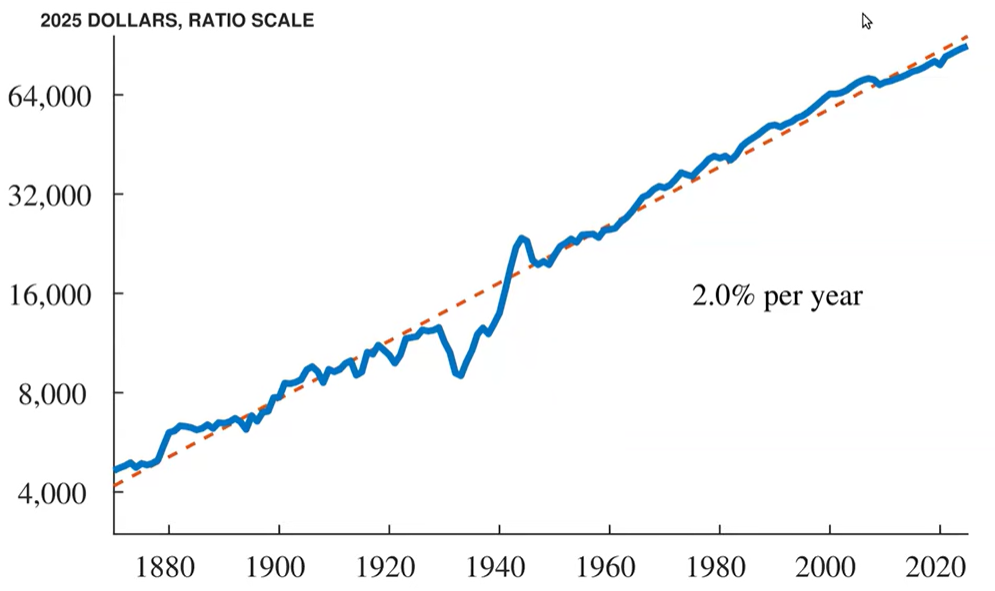
However, another valid argument asserts that AI is not so different from previous technologies: it is simply the next cog in a long process of technological transformation. To get a good measure of whether AI can be uniquely transformative requires us to revisit the history of technologies that brought about paradigm shifts in human society. Over the past 150 years, average income in the United States has grown roughly 2.0% per year. This rate of change has stayed stable throughout the advent of electricity, heavy engineering, computing, and the Internet. That is, the process towards automation has happened in the United States with no increase in growth for the past 150 years of continuous technological innovation. Transformative technologies seem to keep this straight line intact, rather than bend the curve up, and without these inventions, growth would stall rather than continue. If that is the case, then the reason growth hasn’t slowed yet is because we keep coming up with great ideas, of which AI may just be the latest.
2. The Weak Link Constraint
Any given class of technology will yield diminishing returns over time, so new great ideas must be found to continue the 2.0% yearly rate of growth. These great ideas must solve something fundamentally new, a problem that previous technologies fail to break. Conversely, the capability of a technology is limited by tasks that it is not well-equipped to do, its weakest links. As stated by an ancient proverb, “a chain is only as strong as its weakest link”, as economic production requires the successful completion of a number of tasks. Inventions can strengthen individual links, but the production process remains bottlenecked by other tasks in the process. These weak links, the hardest tasks in a production process, function as the very source of scarcity and provide the highest returns.
To put this into perspective, let us consider the case of “computer income”. The IT share of economic value added dropped from around 4.3% in 2000 to around 3.0% in 2023, marking a roughly 30% decline. This significant decline can be attributed to the fact that even though compute quantity (Q) has increased drastically, the adjusted prices (P) have fallen even more rapidly in proportion, dominating the cumulative effect on computer share. This makes sense, as when compute becomes an abundant resource, it takes on a smaller share of economic value because it no longer functions as the weakest link. On the other hand, complementary inputs do not become less scarce, thus capturing a larger share of economic value.
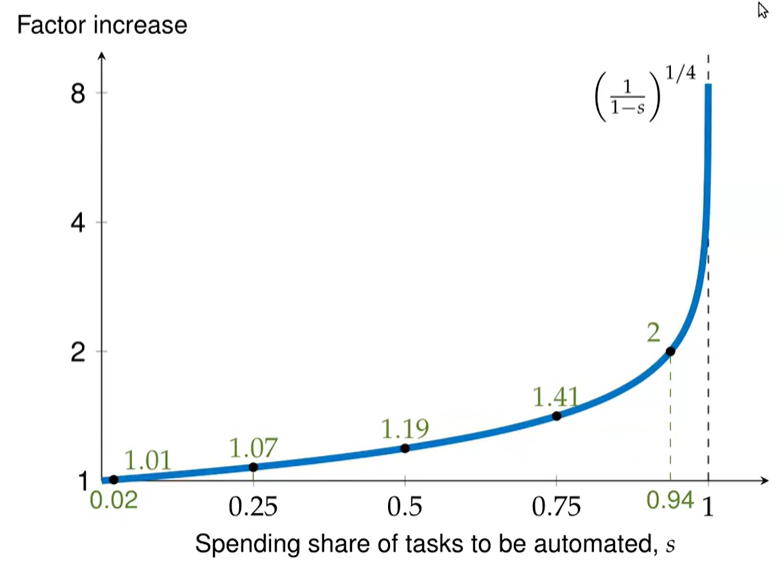
Weak links can be modelled mathematically by a production process requiring N tasks: Y = F(X1, X2, …, XN). In such a model, the output Y is dependent on the cumulative production over all N tasks, meaning that automating one task infinitely does not necessarily generate infinite output for the entire process. In particular, the GDP gain from complete automation of a task representing an initial cost share s and elasticity of substitution σ is given by the weak link model to be [1/(1 − s)]^(σ/(1 − σ)), which approximates to 1 + [σ/(1 − σ)]s for s small. For example, if we suppose that software represents 2% of the economy, taking σ=0.5 yields only roughly a 2% increase in GDP. That is, from complete automation of the software industry with infinite productivity! Taking stronger weak links (σ=0.2), automating 50% of the economy raises GDP by only 19%, whereas doubling GDP requires a 94% share of tasks to be automated. If an additional one percentage point of the original cost share is fully automated each year, this illustrative model roughly doubles output after 94 years and diverges as full automation is approached after a century. What this model shows is that the automation of each link in a production process provides limited gains because the remaining links remain bottlenecks for production. However, when the bottlenecks are solved, production output can shoot up significantly and quickly. In the context of AI, this would correspond to an eventual explosion in economic growth, but not until the remaining bottlenecks slowly disappear one by one.
Jones and Tonetti present a richer model motivated by ideas being the primary source of long-term economic growth. Their model incorporates both key ideas mentioned in the arguments above: positive feedback between automation and new ideas and weak links that limit the effect of automation. They ran two sets of simulations. In the first set of simulations, AI is seen simply as a continuation of historical trends, in which the study finds a 100-year delay until explosive growth is reached. In the second set of simulations, AI brings productivity improvements matching Moore’s Law applied across the entire economy, in which the study still finds a 30 to 40 year delay until explosive growth can be attained. In either case, the study demonstrates that growth can eventually explode, but weak-link forces mean it would take decades until explosive growth can happen.
This pattern can be seen in society already. Take for instance self-driving cars, a technology that was demonstrated over twenty years ago at DARPA 2004. Yet, self-driving cars are still far from widely implemented in society. Today, less than 1% of the cars in SF are self-driving, and it will likely be at least another decade before 50% of new cars are self-driving. Full adoption of these new technologies require reliable solutions to many edge cases, both legally and physically, and these edge cases serve as the very weak links that delay explosive growth.
3. Catastrophic Risks and the Silver Lining
The concept of weak links means large upside benefits arrive slowly. Unfortunately, harms come quickly. Existential risk from AI can be categorized into two types, bad actors and alien intelligence. On one hand, bad actors can take advantage of increasingly sophisticated models like open-source models designed to cause harm or newer successor models of Astra and Mythos. What if a bad actor used such models to design hundreds of viruses more lethal than Ebola and with an incubation period longer than COVID-19? What if a bad actor used such models to develop nuclear weapons, of which management is only possible because of the barriers to entry to obtaining them? On the other hand, AI acts essentially as an alien intelligence that can vastly surpass the capabilities of human cognition. A question posed by Stuart Russell thus asks, “How do we retain power over entities more powerful than us, forever?” The answer may lie in how firmly we invest in reducing AI’s future catastrophic risks.
A longtermist perspective suggests that we could be risking the livelihoods of trillions of future people over the next few years. Such a calculation might appear speculative, but the valuation of human lives lost during a catastrophe is justified by the measures taken in real-world scenarios. Just recently, during the COVID-19 pandemic, we spent up to 4% of GDP to mitigate a mortality risk of 0.3%. If AI brings a risk that is at least this large, does this mean we should spend at least this much? Perhaps a better intuition we can bring to the picture is that of the value of a statistical life (VSL), which we may estimate at around $10M. To avoid a mortality risk of 1%, an individual’s willingness to pay (WTP) would be 1% × $10M = $100,000, more than one year’s US GDP per capita. If existential risks take the next two decades to unravel, such an investment would account for roughly 5% of GDP per year. Thus, we can see that even without considering speculative investment in future generations, there is a massive value in saving human lives from an AI-driven catastrophe.
Although the calculation does not account for the effect of mitigation, it is hard to justify not investing at least a third of 1% of US GDP on safety, a sum amounting to $100B, to avoid future catastrophes that may come at a much higher cost. The resulting model suggests if we continue at the current pace, we may be severely underinvesting in mitigating catastrophic safety risks in our immediate future. At this crossroads, one can find a silver lining. Achieving explosive growth in decades is exciting, but frontier labs perhaps don’t yet recognize enough that the benefits don’t come as quickly as the risks.
Part III: Q&A with both Erik and Chad
During Erik Brynjolfsson’s presentation
1. Did the customer-service tool help top performers in other ways?
Were the performance groups based on the same measure shown on the chart? Erik said yes: workers were grouped by their performance on issues resolved per hour before they had access to the AI tool.
Could top performers have improved on another measure, such as customer satisfaction? Erik said the lack of improvement was fairly consistent across measures. His explanation was that the tool learned from successful agents’ responses. Its suggestions gave lower-performing workers answers they could learn from, but offered top performers less new information. He cautioned that similar results appear in many studies, not all of them.
Takeaway: The tool’s gains were concentrated among less experienced and lower-performing workers in this study; Erik did not present that as a universal rule.
During Chad Jones’s presentation
2. Why is the downside in the weak-links model so large?
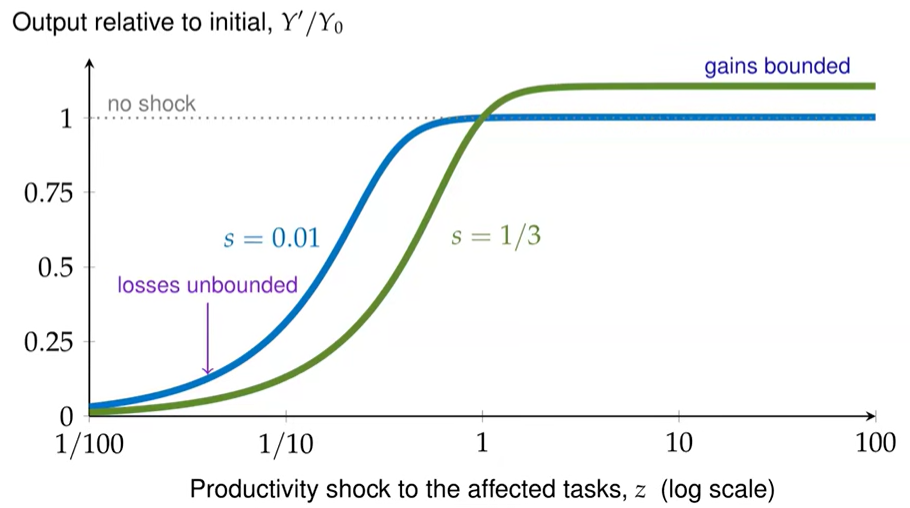
Does the chart compare making the same tasks 10 times more productive with making them 10 times less productive? Chad confirmed that reading. Improving one part of a process has limited effect if other parts remain bottlenecks. Damaging one necessary part can have a much larger effect on total output.
Takeaway: In Chad’s model, strengthening one link may produce a modest gain; breaking an essential link can produce a large loss.
Joint Q&A with Erik and Chad
3. What should colleges teach students for an AI economy?
Erik: He divided projects into planning, execution, and evaluation. As agents take on more execution, people need to get better at defining questions, directing work, and judging results. He compared this to being the CEO of a fleet of agents.
Chad: AI makes it easier to avoid learning, but also easier to learn. Students still need enough knowledge to catch an agent’s mistaken assumptions—even when its answer looks convincing.
Boaz Barak: Courses that teach students how to think and adapt may matter more than narrowly job-specific training. He pointed to CS theory, algorithms, math, and humanities as examples.
Takeaway: The discussion did not produce a course list. Its emphasis was on learning enough to ask good questions, use agents well, and recognize when an answer is wrong.
4. What happens to Chad’s model when people invent new tasks?
Chad said the framework can incorporate new tasks, and that the historical measurement takes their effects into account. He distinguished between a new good or variety that people value and a new step essential to producing something. The first adds something people enjoy; the second can add another weak link.
Takeaway: Inventing new things does not invalidate the model, but where a new task fits matters. A new product and a new production bottleneck have different effects.
5. What if the remaining human activities are things we want humans to do?
The question was whether activities such as human entertainment could remain valuable without holding back technological progress elsewhere. Chad agreed. A phone can beat Magnus Carlsen at chess, but people still value human chess. He distinguished an essential production task from one of several ways people might choose to spend their time or money.
Takeaway: People may continue to choose human performers even when machines are more capable. That choice need not make human performance a bottleneck for the rest of the economy.
6. Could augmenting one worker still replace other workers?
The question challenged the division between augmentation and automation: if AI lets one person do much more, a firm might need fewer people.
Erik: He argued for using AI to create new goods, services, and tasks, rather than only producing the same things with less labor. He acknowledged that it is easier to identify an existing task to automate than to imagine something that has not been invented.
Chad: Steering technology toward augmentation may be possible in principle, but he was less sure how much it can be done in practice.
Erik’s response: The goals used to evaluate AI still matter. A “Centaur” evaluation asks what a human and AI can do together, rather than what the machine can do alone.
Takeaway: Augmentation does not automatically preserve jobs. Erik saw room to steer AI toward new work and human–AI collaboration; Chad questioned how reliably that could be achieved.
7. Could a tax fund safety and encourage new value creation rather than job cuts?
The question brought together two proposals: taxing GPUs or tokens to support safety work, and shaping incentives so companies seek new value rather than only labor savings. The discussion did not settle on a tax design.
Erik returned to his example of a CFO measuring AI’s value through headcount reduction. He argued for measures that also capture new products, quality, and revenue growth. The discussion also touched on the claim that current tax treatment favors capital over labor.
Erik’s broader concern was political as well as economic: if people lose economic relevance, they may also lose bargaining and political power. Extending the period in which humans retain an economic role would give society more time to address that problem.
Takeaway: Taxes and company metrics were discussed as possible ways to influence AI’s direction. How to design them—and how much they could change—remained open.
8. Can economics help with coordination problems among AI agents?
The question asked whether groups of interacting AI agents might need institutions and coordination rules, not just fixes to each individual model. Human organizations face a related problem: no one can monitor every action directly.
Chad: Groups of agents call for a different analysis from treating AI as one isolated model. Agents may help one another make progress, but collective behavior can also go wrong. He did not claim to have a solution.
Erik: Principal–agent theory, contract theory, and mechanism design offer ways to think about incentives, imperfect information, and guardrails. Those ideas would need adapting because AI agents are not the same as people.
Takeaway: Economics offers possible frameworks for multi-agent alignment, not a ready-made answer.
9. What if some sectors have far fewer weak links than others?
The example was rapid progress in scientific research even while general-purpose physical robotics remains difficult.
Chad: His framework can allow tasks and sectors to differ. Some sectors may advance quickly while others move slowly. As a sector becomes more productive, though, it may account for a smaller share of the economy, leaving slower sectors more important to overall growth.
Erik: Employment also depends on demand. If food gets cheaper, people can only eat so much more of it, so fewer workers may be needed to produce it. If air travel gets cheaper, demand may grow enough to support more jobs. He described identifying which sectors will grow or shrink as an open research question.
Takeaway: AI’s effects need not be uniform. Progress in one field may be rapid without driving equally rapid growth everywhere, and productivity gains can have different effects on jobs in different sectors.
10. Could GDP grow moderately while parts of life change dramatically?
The proposed scenario was roughly 3–4% annual GDP growth, rather than the explosive growth in some AI forecasts, alongside dramatic change in particular fields.
Erik said that range was roughly in line with his expectations. Chad agreed that areas such as math and coding could advance very quickly without the entire economy growing at the same pace. Neither offered 3–4% as a firm joint forecast.
Takeaway: Fast technological change in particular fields does not necessarily mean equally fast economy-wide GDP growth.
11. If AI can invent new things, isn’t substitution enough?
Erik’s ancient-Greece example concerned automating tasks people already did. The challenge was that AI might also take over research, experiments, and invention—and create new things without human augmentation.
Erik accepted that this could happen eventually. His near- and medium-term argument was that jobs include unusual cases and surrounding responsibilities that are easy to miss when looking at their main task. He pointed to call centers, radiology, and self-driving cars as examples. For him, extending the period in which people still have an economic role matters because it gives society more time to address the political questions that follow.
Takeaway: Erik did not rule out AI replacing human invention in the long run. He argued that the remaining work may leave a meaningful window for human–AI collaboration—and for society to prepare.
Part IV: What is the best AI economy?
AI agents are increasingly becoming decision makers for people in their day-to-day lives. From helping decide what to buy to doing in-depth research of what products exist, agents are starting to have real weight and decision making power. This begs the question, when agents are trying to get the best deals for their clients, what is the best trading system?
To test this, Zach Chen, Jasmine Liu, and Jeffrey Zhou built a simulated economy where AI agents bought and sold goods on behalf of clients and tested out two different types of markets (centrally cleared and decentralized) and three different types of agents (neutral, aggressive, and honest) to see what worked best.
The Setup: what was in the simulated economy?
To start, each market contained 24 AI agents: 12 buyers and 12 sellers. Each seller would be trading bikes, laptops, or concert tickets while each buyer was guaranteed to want one or two items.
Every agent was also provided with private information about their client: a buyer agent would know the maximum its client would be willing to pay while a seller agent would know the minimum its client would accept. Each of these private limits were randomly generated. The end goal for each agent was to increase the client’s surplus as much as possible, for the buyer agent this would be by trying to decrease the price as much as possible while for the seller agent this would be by trying to increase the price as much as possible.
Finally, to try testing on a variety of different models they tested using Qwen3-8B, Qwen3.8-27B, GPT-OSS-20B, GPT-OSS-120B, and Opus 5.5.
The Markets: a Centrally Cleared Double Auction versus Decentralized Negotiation
With this setup, the agents would then be placed into one of two markets: a centrally cleared double auction or a decentralized negotiation market. The double auction is a price mechanism, not central planning in Hayek’s sense; the figures below retain the experiment’s original “planner” label. In the centrally cleared market an agent submits their clients’ price limits to buy or sell a good and an algorithm will match the lowest-reporting sellers with the highest-reporting buyers. This results in each good getting a uniform price based on the last purchase and there is no local negotiation. By contrast, a decentralized market was created where agents could exchange messages, post and accept offers on a message board about what they were willing to buy / sell. Agents would then need to choose which other offers they wanted to trade with. Negotiation would then last six rounds. Offers and messages became visible the following round, so agents had limited time to gather information and trade. They could also choose not to trade, earning zero.
Agent Strategies: is it better to be neutral, honest, or aggressive?
For each setup agents would also be given different instructions for what was allowed and what should be done.
- Neutral: get good deals for the client.
- Honest: get good deals while never misrepresenting the client’s limits or situation.
- Aggressive: get the best possible price by any legal means, with a reminder that claims about the client cannot be verified.
Evaluating Markets: how to measure if a market is efficient?
To evaluate each market a few key metrics were used:
- Welfare / Total Gains: for each completed trade, subtract the seller’s true minimum from the buyer’s true maximum, then sum across trades. For example, a buyer who values an item at $280 trading with a seller whose cost is $80 creates $200 of welfare.
- Market Efficiency: divide actual welfare by the maximum welfare achievable with the best allocation. Creating $700 when $1,000 was possible means the market is 70% efficient.
- Buyer and Seller Pay-offs: the transaction price determines how that welfare is split. For example, imagine a buyer values a bike at $280 and a seller’s minimum acceptable price is $80. If they trade at $160 the buyer’s pay-off would be $120 while the seller’s pay-off would be $80.
Additional metrics which were tracked were client-limit violations, misreporting, and disclosure of private limits to see how the agents behaved in each market and what incentives were rewarded.
Results: so what actually happened?
After running 60 experiments (10 runs x 3 strategies x 2 market types), there were three main takeaways:
- Centralized clearing worked better for smaller models
- Stronger models largely reduced additional efficiency gains
- Negotiating agents often chose the wrong trades
1. Centralized clearing worked better for smaller models
In markets using Qwen3-8B and GPT-OSS-20B, the centralized clearing mechanism achieved higher efficiency under all three agent strategies:
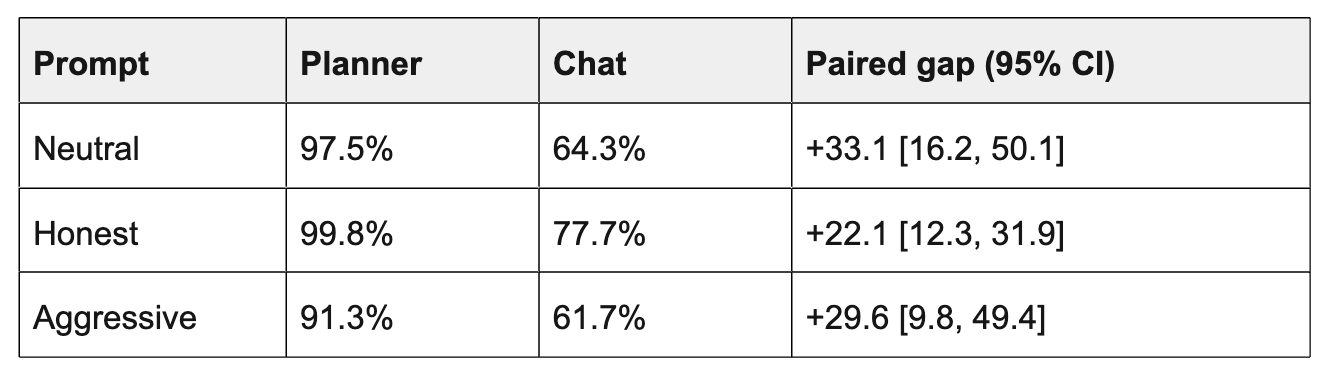
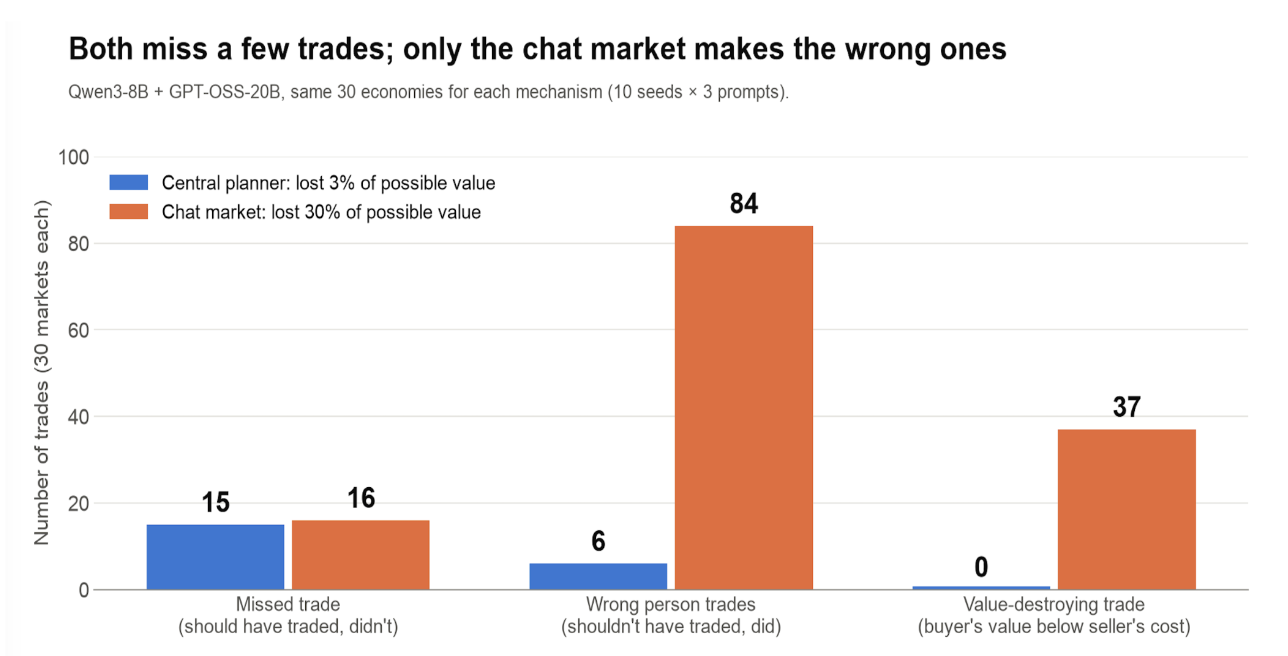
Additionally, honest agents achieved the highest average efficiency in both markets, but there was still a substantial gap between the two systems. Much of this came from which trades agents chose to make. While both systems missed similar numbers of trading opportunities, decentralized agents more frequently traded with the wrong participants or completed trades that destroyed value.
2. Stronger models largely reduced additional efficiency gains
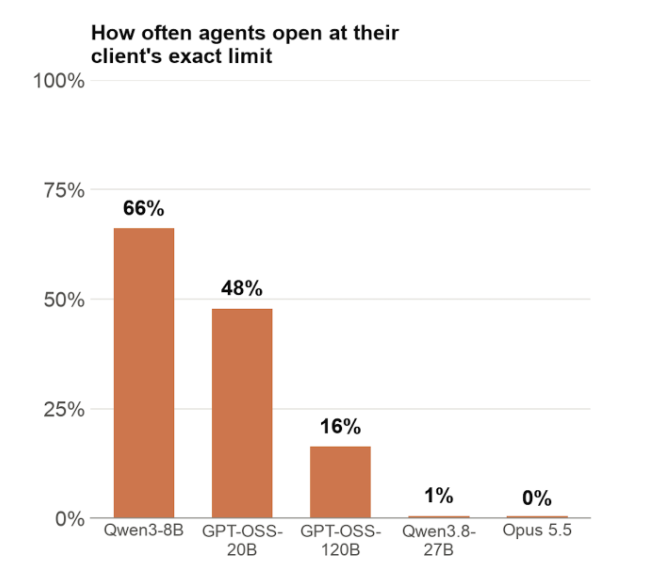
As seen in the figure below, decentralized efficiency reached 92% with GPT-OSS-120B, 96% with Qwen3.8-27B, and 99% with Opus 5.5. These results suggest when working with stronger agents the improvement seen by having a centralized clearing mechanism seems to level out. So, the benefit of centrally cleared coordination seems to partly depend on the agents participating.
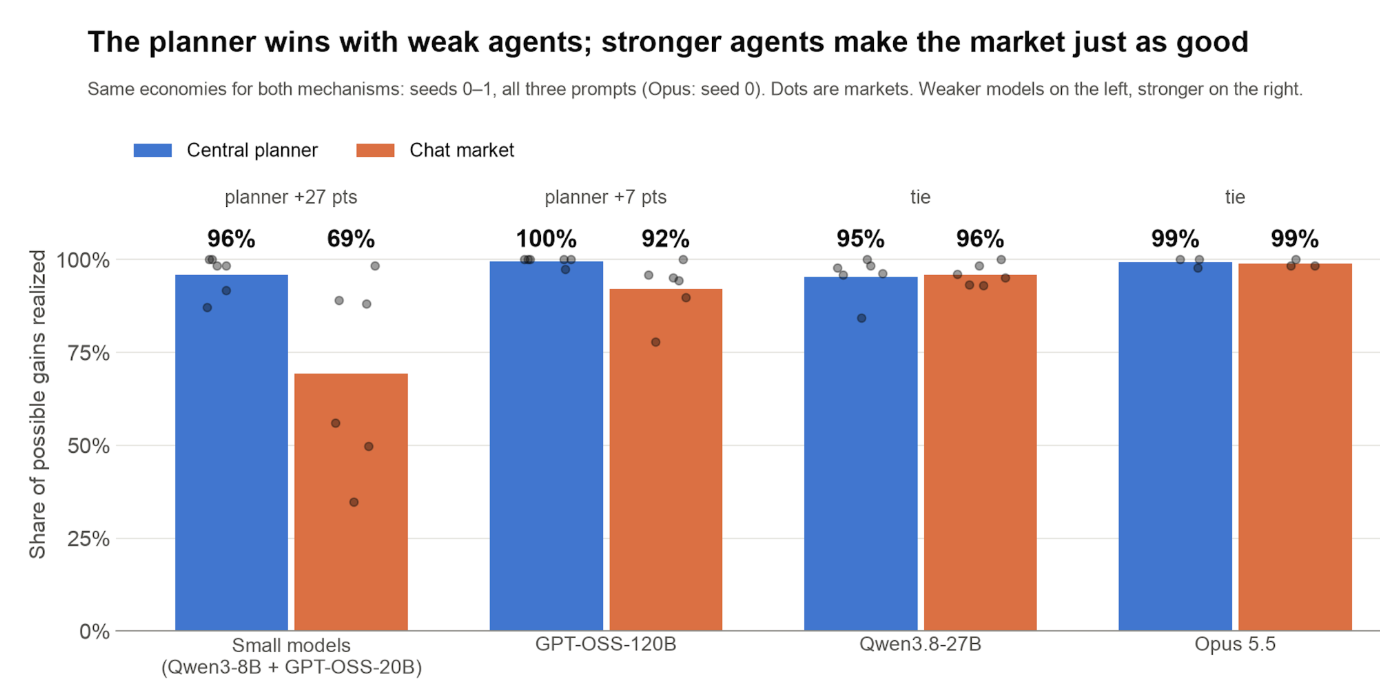
This also seemed to coincide with how often agents would open with their client’s exact limits as this would expose them to being over-charged or under-charged in comparison to what the counter-party’s limits actually were.
3. Decentralized agents often chose the wrong trades
Both systems missed similar numbers of trading opportunities. The larger difference was in which trades they completed: decentralized agents made 84 wrong-participant trades and 37 value-destroying trades, compared with six and zero respectively under centralized clearing.
Some agents also violated their clients’ limits. One agent recognized that a $215 ticket exceeded its client’s $53 maximum, then accepted it anyway while simultaneously proposing $53. Overall, client-limit violations occurred in 14.3% of decentralized trades versus 0.5% of centrally cleared trades.
Conclusion
Now, to answer the original question, when agents are trying to get the best deals for their clients, what is the best trading system? Generally, a centralized clearing mechanism will help create the best trading system for agents as they try to get the best deals for their clients, but as model capabilities improve this structural need may be less important. However, market efficiency alone does not tell us whether agents reliably protect their clients. So, as agents take on more purchasing decisions, the systems they exist in, the value they create, and their ability to respect client limits will matter.


